Quick Answer
Calcite is a multicolored crystal used in modern crystal healing for clarity, calm, and creativity. It measures 3 on the Mohs hardness scale. In the chakra tradition, Calcite is associated with the Crown chakra.
Worth knowing: Calcite's famous double refraction only shows itself in transparent single crystal material: the Natural History Museum of Utah notes that a line viewed through a clear crystal appears doubled, while the massive varieties, which is the seven massive varieties, from blue through red and both Lemurian names, are just as birefringent and show you nothing.
“The calcium carbonate species behind ten catalog varieties, where color is the only thing that changes.”
- Chakra
- Crown (Sahasrara)
- Zodiac
- Cancer ♋
- Element
- Water 💧, Earth 🌍
- Planet
- Moon 🌙
- Hardness
- 3 / 10 (Mohs)
- Colors
- Multicolored, Colorless, Orange, Blue, Honey, Green, Pink, Red, White
- Origin
- Mexico, Argentina, Morocco, Peru, Iceland, USA
- Availability
- Not sold here yet
Care + Safety
Calcite at a glance
- Water: avoid, may damage or leach
- Sun: fades in prolonged direct sun
- Mohs hardness: 3 (display + meditation only)
What is Calcite?
Calcite is a mineral species, calcium carbonate (CaCO3) crystallizing in the trigonal system, and all ten calcites in the CrystalStones.com catalog are that one species wearing different colors. The Geology.com mineral profile gives a specific gravity of 2.7, a vitreous luster, and a hardness of 3, which is less a measurement than a definition, since calcite is the mineral the Mohs scale uses to fix that rung. Only two of the ten names mark a real change in the chemistry, manganoan and cobaltoan calcite, where manganese or cobalt takes some of the calcium's place in an otherwise identical lattice. The rest are color names, and Lemurian is a dealer's prefix.
Calcite measures 3 on the Mohs scale and shows multicolored, colorless, or orange coloring. Call it a desk stone: the catalog assigns it clarity, calm, and creativity, the work of lifting fog before words or decisions land.
The stone connects primarily to the Crown (Sahasrara) chakra, carrying Water and Earth energy. Sources include Mexico, Argentina, Morocco, Peru, Iceland, and USA; deposit matters more than beginners expect, and collectors learn to recognize where a piece of Calcite was mined by its color depth and pattern.
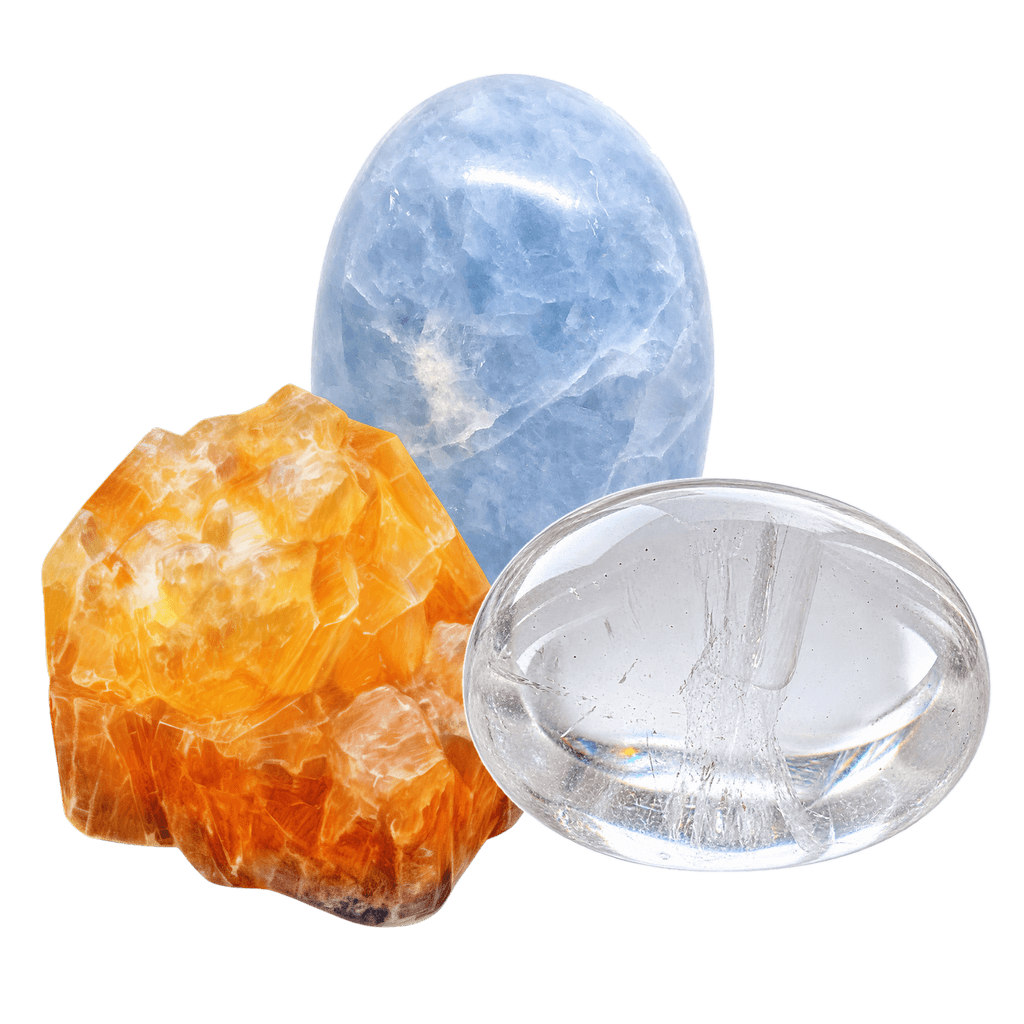
Calcite is the family, not the stone. Set an orange one, a milky blue one and a clear rhomb side by side and the only thing that has actually changed is the color: the same soft give under a fingernail, the same cool weight, the same bruised edge where somebody was careless. In my practice the useful question is never which calcite is strongest. It is which color earns the shelf you actually walk past.
Also catalogued as Calcium Carbonate and Iceland Spar, this is a stone that rewards regular handling more than display. Give Calcite a week of clarity duty in the pocket before deciding what it is for.
The calcite name covers 10 stones in this catalog, each with its own entry: Blue Calcite, Honey Calcite, Green Calcite, Orange Calcite, Mangano Calcite, Cobalto Calcite, Lemurian Aquatine Calcite, Lemurian Blue Calcite, Red Calcite, Clear Calcite.
History and Mythology
Calcite's history is mostly not a history of jewelry, it is a history of scale. Limestone is by definition a rock at least half calcium carbonate as calcite by weight, marble is that limestone recrystallized by heat and pressure, and the US National Park Service calls calcite the most common cave mineral: stalactites, stalagmites and sheets of flowstone are all calcite left behind as dripping water gives up its carbon dioxide. The Natural History Museum of Utah records the extreme case, a single calcite crystal measured at 7 by 7 by 2 meters and reported at 250 tons, found in basalt at Eskifjord in Iceland. A cathedral facade, a cave ceiling and a three dollar tumbled pebble are the same compound at three different scales.
One calcite story circulates as fact and is better as the thing it actually is. In 2011 Ropars, Gorre, Le Floch, Enoch and Lakshminarayanan published a paper in Proceedings of the Royal Society A proposing that a rotated calcite crystal would work as a depolarizer precise enough to locate the sun through overcast, the so called Viking sunstone. That is a hypothesis about what would have been possible, not a record of what was done, and no calcite has been recovered from a Viking age ship or grave. What was recovered is a calcite crystal from an Elizabethan ship that sank off Alderney in 1592, more than five centuries after the Viking age ended, which is its own kind of strange.
Calcite Meaning and Metaphysical Properties
What the Hand Learns First
The hand learns Calcite fast: a Mohs 3 stone whose multicolored face warms readily and carries a soft luster that invites the thumb to keep circling it. Notice the visual field; people working with the clarity stones often describe the room sharpening slightly, attention gathering to a point.
Primary Properties
Clear thinking is the thread tying the Calcite properties together: clarity, calm, creativity, release, and healing. The family earns its keep at the desk and in the hard talk, wherever language needs a clean runway. Set the stone out at the start of each session and put it away at the end; the repetition is the method.
How Crystal Energy Works
Calcite sits at the Crown in the traditional map, the threshold between your own field and the wider one, where clarity is the standing petition. Handle Crown work lightly, short sits and soft attention, treating clarity, calm, and creativity as a long arc instead of a daily quota. Judy Hall groups the clarity stones with the throat and brow centers, and her entries for the family read like study aids: focus, articulation, honest speech.
Amplification Through Intention
Calcite carries Water in the elemental system, feeling, memory, tide, and that current sets the tempo of its clarity work. Use the slow hours, journaling, the evening review, the long unwinding, and let clarity, calm, and creativity arrive at their own pace.
Healing Benefits
Emotional Support
The emotional gift of Calcite is composure: clarity, calm, and creativity. It is a stone for tangled-thread days, when the feeling is real but the words for it keep slipping out of reach. As with all crystal healing, clarity support from a stone is reflective practice rather than medicine; significant emotional concerns deserve qualified human help.
Spiritual Connection
Truth-telling is the spiritual lane Calcite runs in: the unflinching journal, the conversation that finally happens. Tradition assigns it to the practices of honest seeing and honest saying, worked at the Crown center.
Physical Presence
Physically, Calcite keeps company with the soft systems, rest and recovery, the long exhale after effort toward clarity. Its honest job is reminding you to downshift; anything medical belongs with medical professionals.
Chakra Connection
Calcite resonates most strongly with the Crown (Sahasrara), the energy center traditionally drawn in violet / white and the traditional seat of this stone's clarity work. When this center runs clear, the classical markers are openness to the sacred, perspective beyond the personal, and an undercurrent of unity; clarity, calm, and creativity are what Calcite is most often asked to bring to it.
Lying down, keep Calcite clear of the head altogether, near hair rather than against skin; crown placements sit at the body's edge, and soft attention rather than any measured stretch of it is the traditional clarity session.
Zodiac and Astrological Connection
Calcite appears under Cancer ♋ (Jun 21 to Jul 22) in the standard correspondence tables; if those signs are loud in your chart, expect the introduction to feel familiar.
Correspondence is a suggestion, not a bouncer; plenty of devoted Calcite keepers have no Cancer in their chart at all, and being drawn to the stone is the credential that matters.
Moon 🌙 rules Calcite in this tradition, so practitioners time their longer sessions to that planet's active periods, especially for clarity.
How to Use Calcite
Five practices suit Calcite especially well. Pick the one that fits the day you are actually having rather than the routine you think you should have.
- 1
Meditation Hold
Take up Calcite as you settle in; at Mohs 3 it takes on your warmth within a minute or two, and that slow merge is a useful anchor whenever the mind wanders.
- 2
Body Placement
Above the head, not on it, is where Calcite belongs in a crown session: lie down, position the stone just clear of the crown of the head, and keep the attention gentle. Nothing about this station rewards effort. The old charts assign it to clarity.
- 3
Sleep Companion
At night, park Calcite on the nightstand rather than working it; its job is the day's clarity, and ending the day cleanly is how tomorrow's session starts well.
- 4
Carry With You
Carry Calcite into the long meetings and the hard drafts. A deliberate touch when the thread tangles is a two-second reset, and over weeks it builds a dependable clarity habit.
- 5
Crystal Grid Anchor
Use Calcite as the heart of a small grid for clarity, with Orange Calcite and Blue Calcite alternating on the spokes. Place the stones slowly and set the last one down with the clarity intention named out loud.
How to Cleanse and Charge
A worked stone needs clearing, and Calcite is no exception; practitioners describe an uncleansed crystal as muffled, present but quieter than it should be. For the full safety profile and the cadence I recommend, see the dedicated Calcite care guide.
- 1
Moonlight
Set Calcite on a windowsill or ledge under the full moon and collect it in the morning. Moonlight is the gentlest cleanse in the tradition, safe for every stone in the collection and impossible to overdo.
- 2
Selenite
Keep a selenite dish where you empty your pockets and drop Calcite there at day's end; the resting place does the cleansing while you sleep.
- 3
Sage
Smoke-cleanse Calcite: light the sage, let it settle to a smolder, and move the stone through the rising smoke until your sense of it lightens, usually under a minute.
- 4
Sound
A minute inside strong, sustained tone, bowl, chime, even a steady hum, resets Calcite without physical risk, which makes sound the safest deep cleanse for fragile stones.
How often to cleanse
Give Calcite a clearing at least every month, and sooner after hard weeks or heavy daily use. The stone will teach you its own signal in time; most people describe it as dullness, weight, or a sense the stone has gone quiet.
Charging after cleansing
After cleansing, charge Calcite by setting it on a selenite plate overnight or bathing it in full moonlight. This restores its energetic vitality.
The Crystal Starter Library
A free guide from Crystal Cassandra: the twelve stones that cover almost everything, a one page care matrix for water, sun and salt, and how to build a first intention practice.
We respect your inbox. Unsubscribe anytime.
Crystal Pairings
Calcite pairs functionally: think desk set, not jewelry box. Partners are chosen the way tools are chosen, one for focus, one for voice, one for nerve. Two stones to one clarity task is the working maximum; clarity hates clutter.
Buying Calcite: Price, Quality, and Jewelry
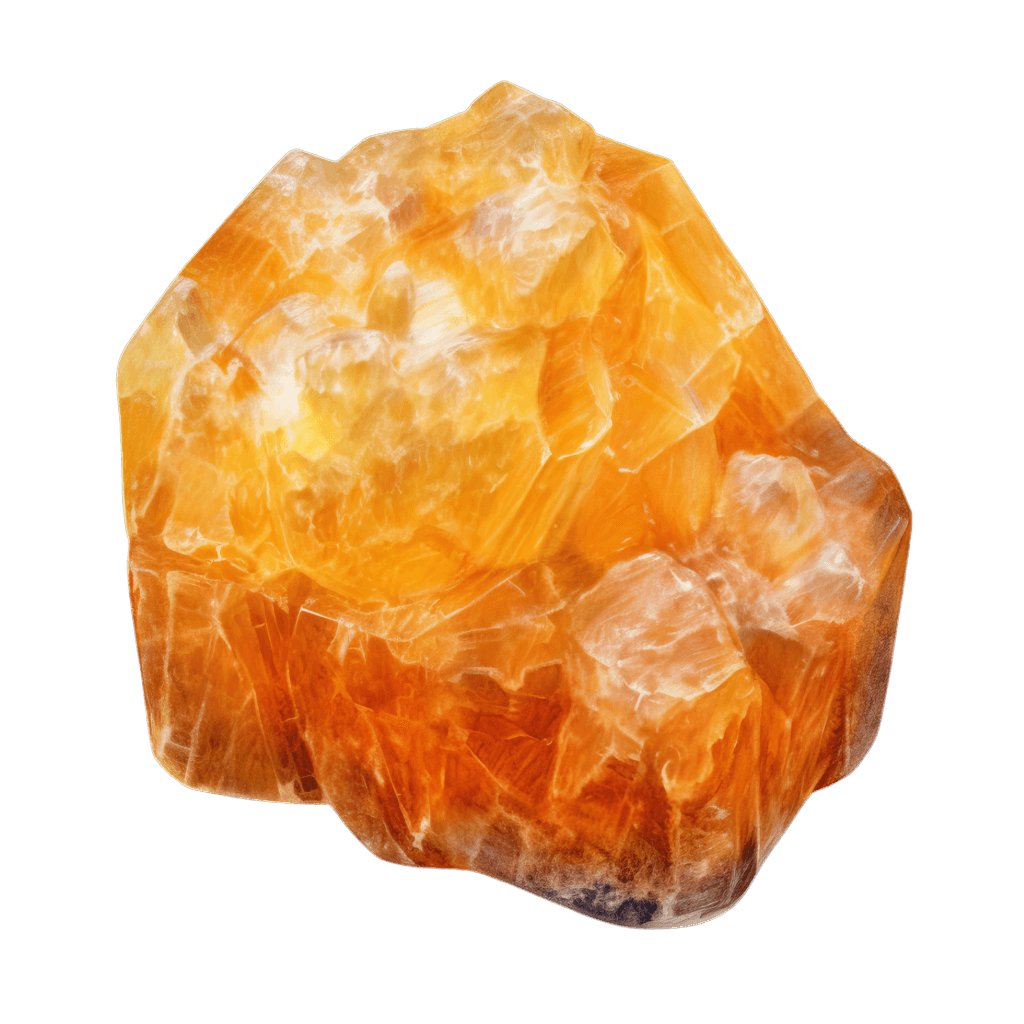
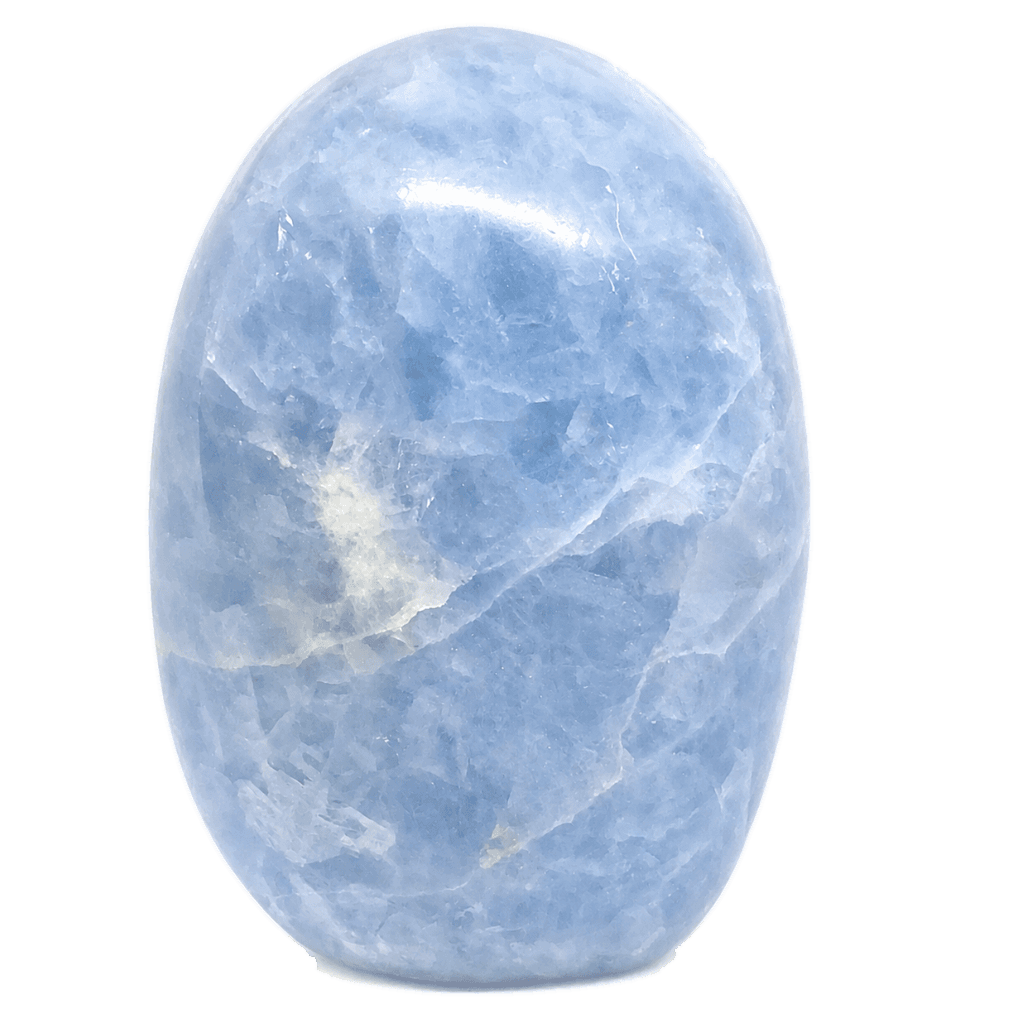
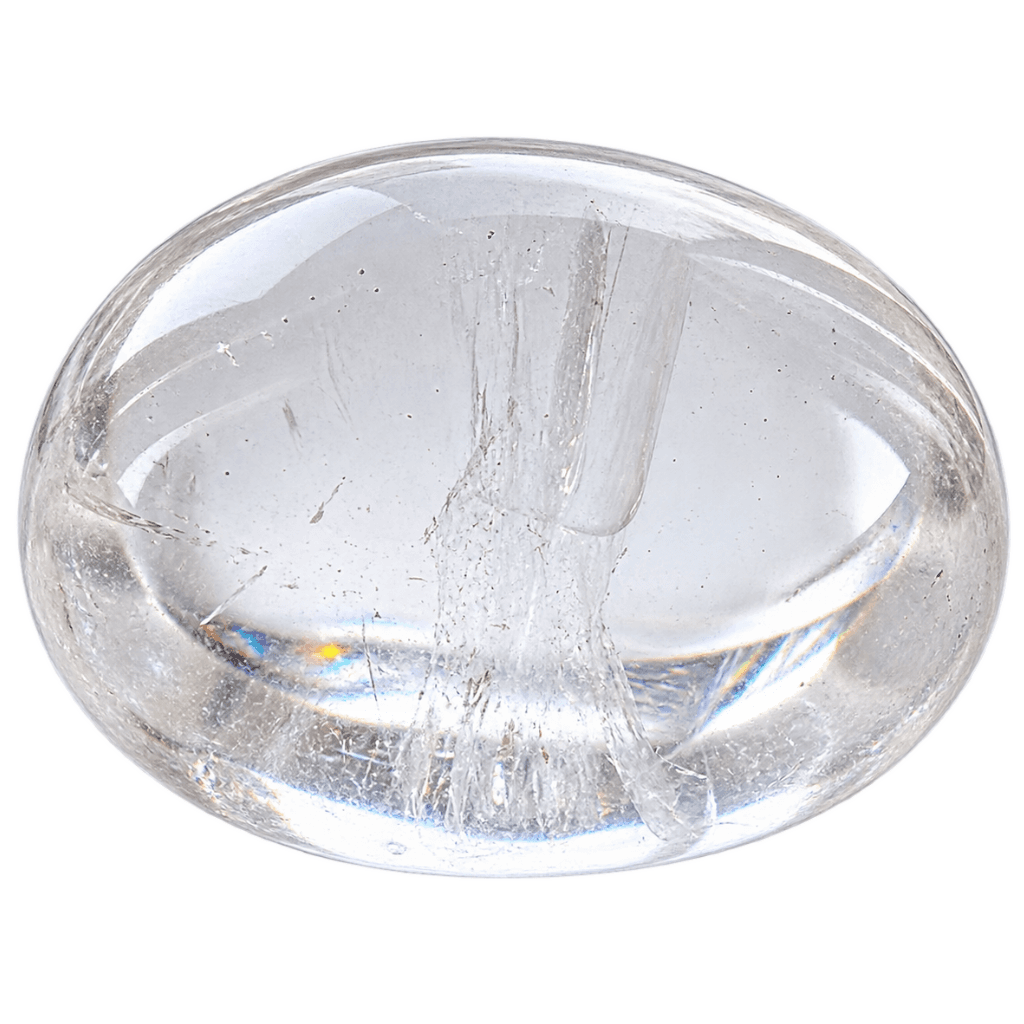
Choosing inside this family is a choice about color, form and locality, never about mineral properties, because the properties are identical across all ten. Start with form, because form decides what a piece can show you. Clear calcite is the only member that arrives as transparent cleavage rhombs. Blue, green, honey, orange and red calcite, along with both Lemurian names, are massive vein material sold as tumbles, palm stones and free forms, bought for even color and the sea glass glow they take on when backlit. Mangano and cobalto calcite usually come the third way, as crystallized or druzy crusts on matrix, which makes them display pieces first and pocket stones a distant second.
Then choose by what put the color there. Iron oxide staining between the grains covers the warm end of the range, so honey, orange and red calcite are one iron tinted sequence and picking among them is picking a shade. Mangano and cobalto calcite are the only varieties whose color comes from a genuine change in the crystal chemistry rather than from an inclusion, which is also why they cost what they cost.
Market figures, for orientation only. The CrystalStones.com store is not open, so nothing here is an offer or a promise that any of it is available from us. In the wider market in August 2026, common massive calcite is among the least expensive colored stone on sale: tumbling rough trades around $12 to $20 a pound at wholesale, single tumbled pieces list at a few dollars, and palm size polished free forms sit near $10 to $25. Clear calcite is cheaper than its reputation suggests, because clarity rather than size sets its price and small cleavage rhombs are common. Cobalto calcite is the outlier by a wide margin, with display grade plates listing in the low hundreds. Five things move price across the family, worth reading in this order: grown crystal versus massive vein material, transparency, evenness and saturation of color, size combined with intactness, and locality. Hold a piece up to a window and notice whether the color runs all the way through or sits only on the polished skin. A perfectly uniform, unusually large, unusually cheap piece is the combination worth questioning, because in this family those three qualities do not normally travel together.
How to Spot Real vs Fake Calcite
Imitations of Calcite exist because demand does. A few hands-on checks separate genuine multicolored material from glass, resin, and dye:
Temperature: at Mohs 3, genuine Calcite warms in the hand noticeably faster than glass; an imitation in glass stays cold and slick well past the first minute.
Weight: real Calcite should feel like stone rather than plastic pretending; if a palm-sized piece feels nearly weightless, walk away from it.
Color and pattern: the real range is multicolored, colorless, or orange; treat neon saturation or flawless uniformity as a question for the seller, because nature rarely manages either.
Trust your source: provenance beats any hands-on check; ask where the Calcite was mined and whether the multicolored material is treated, and expect straight answers rather than adjectives.
Frequently Asked Questions
What is Calcite good for?
Calcite is traditionally associated with clarity, calm, creativity, and release. Many people find it supportive for clarity and for working with the Crown chakra.
Can Calcite go in water?
No, water and Calcite do not mix; moisture can compromise the surface or the structure itself. One rule governs all ten varieties and it comes from the species rather than the color: keep calcite dry. It is soft enough to scuff against almost anything it shares a pouch with, and it dissolves in the weak acids that make it fizz in the field test, so vinegar, citrus and acidic sprays etch a polished surface to a dull bloom. Cleanse dry and store each piece on its own.
Can Calcite be in the sun?
Keep it brief. Prolonged direct sun can fade the multicolored coloring of Calcite, so a few morning minutes are fine but moonlight is the safer charging method.
What chakra is Calcite?
Calcite is primarily associated with the Crown (Sahasrara) chakra. Just clear of the head, off the body itself, is the crown convention, in seated or lying-down practice alike, for clarity work.
What zodiac sign is Calcite for?
Calcite is traditionally connected to Cancer. That said, the zodiac correspondence is an invitation rather than a requirement; any chart can work with Calcite, and attraction to the stone matters more than the calendar.
How do I cleanse Calcite?
The best methods for Calcite are Moonlight, Selenite, and Sage. One rule governs all ten varieties and it comes from the species rather than the color: keep calcite dry. It is soft enough to scuff against almost anything it shares a pouch with, and it dissolves in the weak acids that make it fizz in the field test, so vinegar, citrus and acidic sprays etch a polished surface to a dull bloom. Cleanse dry and store each piece on its own.
Is Calcite real or fake, how can I tell?
Genuine Calcite warms quickly in the hand at Mohs 3, while glass imitations stay cold longer and feel slick rather than satiny. There is no single Calcite price, because each variety carries its own market; judge a piece against its own variety and expect visible variation rather than uniformity.
What is the difference between calcite and aragonite?
Calcite and aragonite share one formula, calcium carbonate, and are still two separate minerals, because aragonite packs those same atoms into a denser orthorhombic lattice while calcite uses a trigonal one. The difference is not permanent either: aragonite converts to calcite with heat and over geological time, so the older a carbonate fossil is, the likelier its aragonite has already turned into calcite.
Why does calcite break into little rhombs instead of chipping?
Calcite has perfect cleavage in three directions, and those three directions do not meet at right angles, so a knocked piece rarely loses a corner. It splits clean through along a flat internal plane, often falling apart into a small slanted rhomb. That is also why most clear calcite on the market is a cleavage fragment shaped by breaking rather than a grown crystal with natural faces.
Which calcite actually doubles an image?
Clear calcite is the only variety in this family that will double a printed line, because double refraction is visible only through transparent single crystal material. Every calcite splits light into two rays, but massive orange, blue, green, honey, red and Lemurian material is an opaque mass of countless small grains that scatters both rays, so the massive varieties cannot perform the trick the whole family is routinely credited with.
Is Lemurian calcite a real variety?
Lemurian calcite is a trade name, and the two names in this catalog, Lemurian blue calcite and Lemurian aquatine calcite, differ from each other and from Mexican blue calcite only in shade and finish. Buy them on color, price and how the piece is cut.
How do you tell calcite from dolomite?
Calcite and dolomite are separated by one drop of cold dilute hydrochloric acid at 5 to 10 percent. The Geology.com acid test describes the entire drop erupting on calcite with a vigorous fizz that lasts a few seconds, while on dolomite the reaction is weak or not observed at all unless the acid is warmed or the sample is powdered. Household vinegar shows a milder version of the same contrast.
Which calcite variety should a beginner start with?
Orange calcite is the easiest first calcite, since it is the cheapest, the most widely stocked and the most saturated, so it shows what this family's color looks like at full strength. Clear calcite is the better choice for anyone who wants to watch the mineral do something, because it is the one that doubles a line. Both sit at Mohs 3, so both want dry cleansing and a shelf of their own.
What’s Next?
A few thoughtful next steps if Calcite is calling to you.
Explore More Tools
Crystal Quiz
Discover which crystal matches your energy right now.
Open →Chakra Test
Find which chakras need attention and the crystals to balance them.
Open →Crystal Cleansing Guide
Learn how to safely cleanse and charge your crystals.
Open →Crystals by Intention
Find the perfect crystal for what you need right now.
Open →