Quick Answer
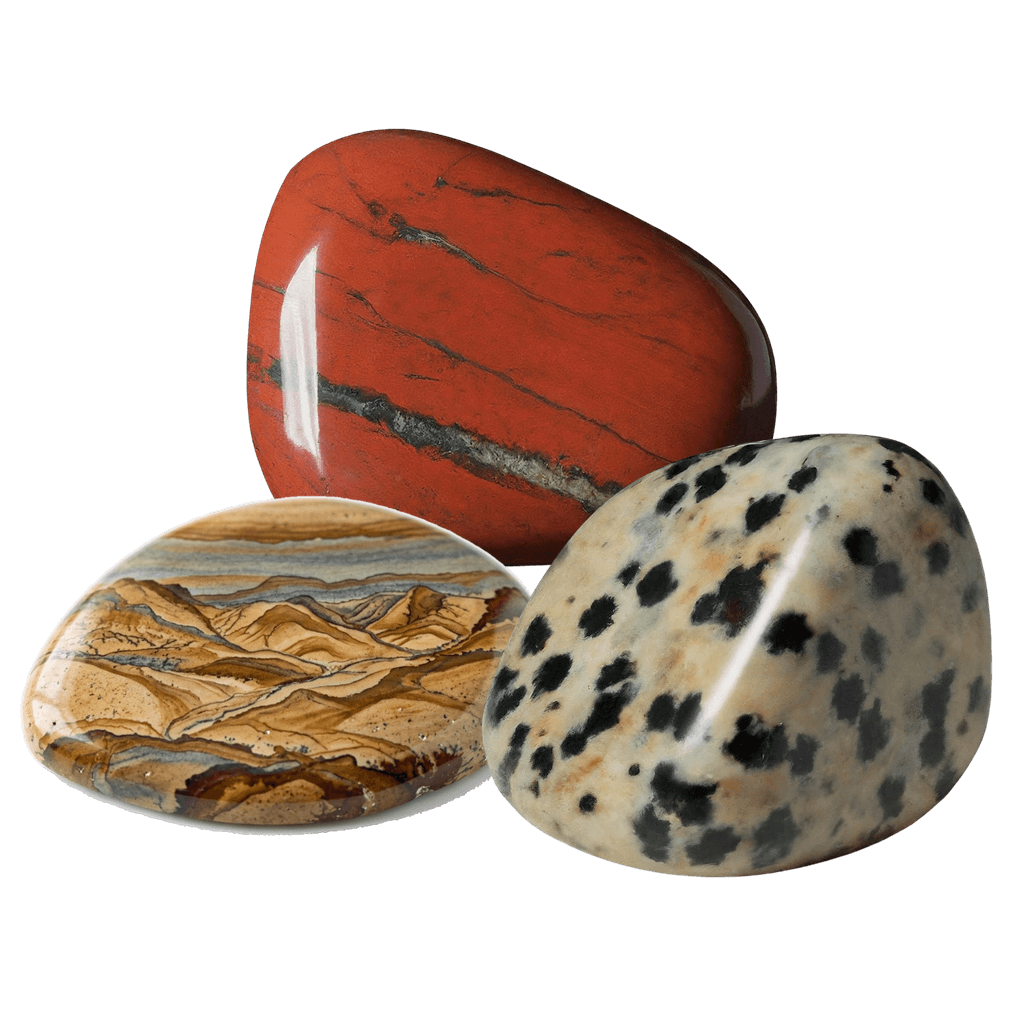
Jasper is a multicolored crystal used in modern crystal healing for grounding, vitality, and courage. It measures 7 on the Mohs hardness scale. In the chakra tradition, Jasper is associated with the Root chakra.
Worth knowing: Of the 19 stones CrystalStones.com lists under the jasper name, at least five are not microcrystalline quartz at all: bumble bee is a carbonate rock colored by arsenic sulfide, kambaba and leopardskin are rhyolites, dalmatian is a spotted igneous rock, and much zebra material is banded marble or quartzite.
“The lapidary name for opaque microcrystalline quartz, and the parent of nineteen catalog varieties, five of which are not jasper.”
- Chakra
- Root (Muladhara)
- Zodiac
- Leo ♌, Aries ♈
- Element
- Earth 🌍
- Planet
- Mars ♂
- Hardness
- 7 / 10 (Mohs)
- Colors
- Multicolored, Red, Yellow, Green, Brown, Black, Banded
- Origin
- Madagascar, Australia, India, USA, Brazil, South Africa
- Availability
- Not sold here yet
Care + Safety
Jasper at a glance
- Water: brief rinse safe
- Sun: tolerates sunlight charging
- Mohs hardness: 7 (durable for daily-wear jewelry)
What is Jasper?
Jasper is not a mineral species, and not a variety of one either. It is a lapidary name for the opaque branch of microcrystalline quartz: Gemdat classes it only as a variety of chalcedony, which is itself a variety of quartz, and Geology.com's Hobart M. King writes that jasper is more a gemological term than the name of a material geologists use. Walter Schumann's Gemstones of the World supplies the reason, recording that dense jasper carries up to 20 percent foreign material, and a rock that is a fifth other minerals is a rock rather than a species. The physical numbers hold steady across real jasper: Mohs 6.5 to 7, specific gravity 2.58 to 2.91, refractive index about 1.54, opaque, and, unlike the calcite family, no cleavage direction at all.
Jasper measures 7 on the Mohs scale and shows multicolored, red, or yellow coloring. It is one of the keeper stones, the protective end of the catalog, most often asked for grounding, vitality, and courage.
The stone connects primarily to the Root (Muladhara) chakra, carrying Earth energy. Today the material is drawn from Madagascar, Australia, India, USA, Brazil, and South Africa. Hold pieces from two different sources side by side and the differences in the multicolored material, tone, translucency, pattern, become obvious fast.
Jasper is a name, not a mineral. Nineteen stones in the CrystalStones.com catalog carry it, and what holds them together is less chemistry than a habit of the lapidary trade: if a stone is opaque, patterned and takes a bright polish, somebody will call it jasper. When you cup one in your palm, the family tell is the dead flat opacity, no glow at the edge, no window into the stone. What you are choosing between here is pattern, not substance.
Also catalogued as Jasper Stone, Iaspis, and Opaque Chalcedony, this is a stone that rewards regular handling more than display. Give Jasper a week of grounding duty in the pocket before deciding what it is for.
The jasper name covers 19 stones in this catalog, each with its own entry: Red Jasper, Mookaite Jasper, Ocean Jasper, Picture Jasper, Leopardskin Jasper, Bumble Bee Jasper, Dalmatian Jasper, Kambaba Jasper, Landscape Jasper, Orbicular Jasper, Red Sesame Jasper, Yellow Jasper, Zebra Jasper, Black Jasper, Green Jasper, Brecciated Jasper, Poppy Jasper, Polychrome Jasper, Blue Jasper.
History and Mythology
Jasper is one of the oldest gem names still in use, and it has been drifting for roughly three thousand years. The word runs back through Old French and Latin to the Greek iaspis and a Semitic root, and the stone it named then was not today's opaque red rock: classical descriptions point to something considerably more translucent and often distinctly green, closer to what a modern gemologist would call chrysoprase. Gemdat glosses the same Greek root as spotted stone. Both readings still survive inside this catalog, which is what a name with no governing authority looks like after three millennia.
Long before it was ornamental, jasper was a working material. Kenoyer and Vidale's 1992 study of Indus Valley stone drills describes fine grained green jasper micro drills used to bore carnelian and chalcedony beads, part of a bead drilling tradition traced back to Neolithic Mehrgarh. The drills worked for a mineralogical reason: microcrystalline quartz is granular and resists heat and breakage, while the fibrous chalcedony being drilled gives way first.
The most modern chapter is a forgery. Pale jasper dyed blue has been sold as lapis lazuli under the trade names Swiss lapis and German lapis since the nineteenth century, classically Nunkirchen material from Germany treated with ferrocyanide. Gemdat still lists that treatment on its jasper entry, with the absence of pyrite recorded as the tell.
Jasper Meaning and Metaphysical Properties
First Touch
Jasper meets the hand cool and composed: at Mohs 7 it takes a glass-bright polish, and that first chill lingers a while before your warmth wins. Notice your weight while you hold it, feet on the floor, seat in the chair; with grounding stones the tradition points attention toward ballast rather than toward tingle.
Primary Properties
The working properties of Jasper cluster at the protective end: grounding, vitality, courage, protection, and energy. This family teaches containment, a settled spine, a slower breath, a clear sense of where you end and the room begins. The list is traditional shorthand; the stone meets whatever version of steadiness you actually need.
How Crystal Energy Works
Ground is the keyword the tradition gives Jasper: a Root-center stone, asked above all for grounding. Work it the Root way, seated, slow, soles flat against the floor, holding grounding, vitality, and courage as the quiet agenda. Melody's Love Is in the Earth describes the grounding stones through the root connection, the energetic cord she pictures running from the base of the spine into the earth itself.
Amplification Through Intention
Jasper is classed as an Earth stone, patient, bodily, hard to knock over, which sets the pace of its grounding work. Prefer routines over ceremonies, the same pocket, the same desk corner, and let consistency do for grounding, vitality, and courage what intensity cannot.
Healing Benefits
Emotional Support
On the emotional level, tradition hands Jasper the boundary work: grounding, vitality, and courage, the felt sense of having walls that hold. It earns its keep on the days when other people's storms blow through you too easily. These are traditional grounding associations rather than medical claims; for anything heavy or persistent, a qualified professional belongs in the picture alongside any stone.
Spiritual Connection
Jasper holds the doorkeeper post in spiritual practice: tradition gives it the opening breath before inner work and the deliberate landing afterward. For this family, a well-kept boundary is itself a form of devotion.
Physical Presence
Physically, Jasper belongs to the slow systems: steady meals, regular sleep, the unglamorous maintenance that grounding actually rests on. Keep it where the routines happen as a quiet vote for keeping them; anything clinical belongs with clinicians.
Chakra Connection
Jasper resonates most strongly with the Root (Muladhara), the energy center traditionally drawn in red and the traditional seat of this stone's grounding work. When this center runs clear, the classical markers are rootedness, calm in the body, and trust in your own footing; grounding, vitality, and courage are what Jasper is most often asked to bring to it.
For placement, go low: lie down with Jasper resting at the hip points, or sit on the floor and set it between your feet. Attention on weight and ground, for as long as that stays comfortable, is the classic root session the tradition records for grounding.
Zodiac and Astrological Connection
In the modern correspondence tables Jasper is assigned to Leo ♌ (Jul 23 to Aug 22) and Aries ♈ (Mar 21 to Apr 19); a Sun, Moon, or rising placement there is read as a head start with this stone, nothing more.
Correspondence is a suggestion, not a bouncer; plenty of devoted Jasper keepers have no Leo in their chart at all, and being drawn to the stone is the credential that matters.
In the planetary layer of the system, Mars ♂ holds the rulership, and that planet's prominent transits are the traditional windows for deeper grounding work with Jasper.
How to Use Jasper
These are the five ways of working with Jasper I suggest most often. Begin wherever your attention goes first; the sequence matters far less than starting.
- 1
Meditation Hold
Take up Jasper and register the first cool touch; a glassy stone at Mohs 7 warms slowly, and tracking that gradual change is a meditation in itself.
- 2
Body Placement
Floor and hip are the two Root stations in the old placement charts, and Jasper takes either one: by the feet during seated work, at the hips when lying back. In my practice the interesting part is never the position itself but what you catch yourself noticing once you stop expecting anything from it, which is how the tradition's grounding work was meant to be entered.
- 3
Sleep Companion
At night, park Jasper on the nightstand rather than working it; its job is the day's grounding, and ending the day cleanly is how tomorrow's session starts well.
- 4
Carry With You
For the loud days, packed trains, hard meetings, difficult rooms, Jasper earns its pocket space. The brief touch becomes a perimeter check, a reminder that grounding is portable.
- 5
Crystal Grid Anchor
For grid work, give Jasper the anchor position and run Jasper Red and Jasper Ocean on the outer points, all matched to a single grounding intention. Rebuild it when it goes stale; a grounding grid you have stopped seeing has stopped working.
How to Cleanse and Charge
A worked stone needs clearing, and Jasper is no exception; practitioners describe an uncleansed crystal as muffled, present but quieter than it should be. For the full safety profile and the cadence I recommend, see the dedicated Jasper care guide.
- 1
Water
Run cool water over Jasper while turning it slowly; when the surface feels fresh under the thumb, dry it well and let it rest before its next use.
- 2
Sunlight
A morning hour in the sun is the active cleanse for Jasper: quick, warming, and best done with the stone resting on a natural surface like wood or stone.
- 3
Sage
Pass Jasper through the smoke of white sage or rosemary for about thirty seconds, turning it so the smoke wraps every face, while you hold a clear intention of release.
- 4
Earth
Give Jasper twenty-four hours in the ground, with the spot marked so you can find it again; earth burial is the slow, thorough cleanse for stones that feel truly saturated.
- 5
Sound
A minute inside strong, sustained tone, bowl, chime, even a steady hum, resets Jasper without physical risk, which makes sound the safest deep cleanse for fragile stones.
How often to cleanse
Monthly is the floor for Jasper; step the cadence up whenever the stone is in daily rotation or the season is emotionally loud. With practice you will feel the tell yourself, a worked stone reads heavier and flatter in the palm.
Charging after cleansing
Once it is cleansed, recharge Jasper by placing it in morning sunlight for 30 minutes; cleansing empties the stone, charging refills it.
The Crystal Starter Library
A free guide from Crystal Cassandra: the twelve stones that cover almost everything, a one page care matrix for water, sun and salt, and how to build a first intention practice.
We respect your inbox. Unsubscribe anytime.
Crystal Pairings
Think of pairing Jasper as staffing a gate: something heavy to hold the line, something quick to keep watch. The traditional companions split exactly that work, boundary on one side, vigilance on the other. Before settling on a pair, hold both for a moment; comfort in the hand is the yes.
Buying Jasper: Price, Quality, and Jewelry
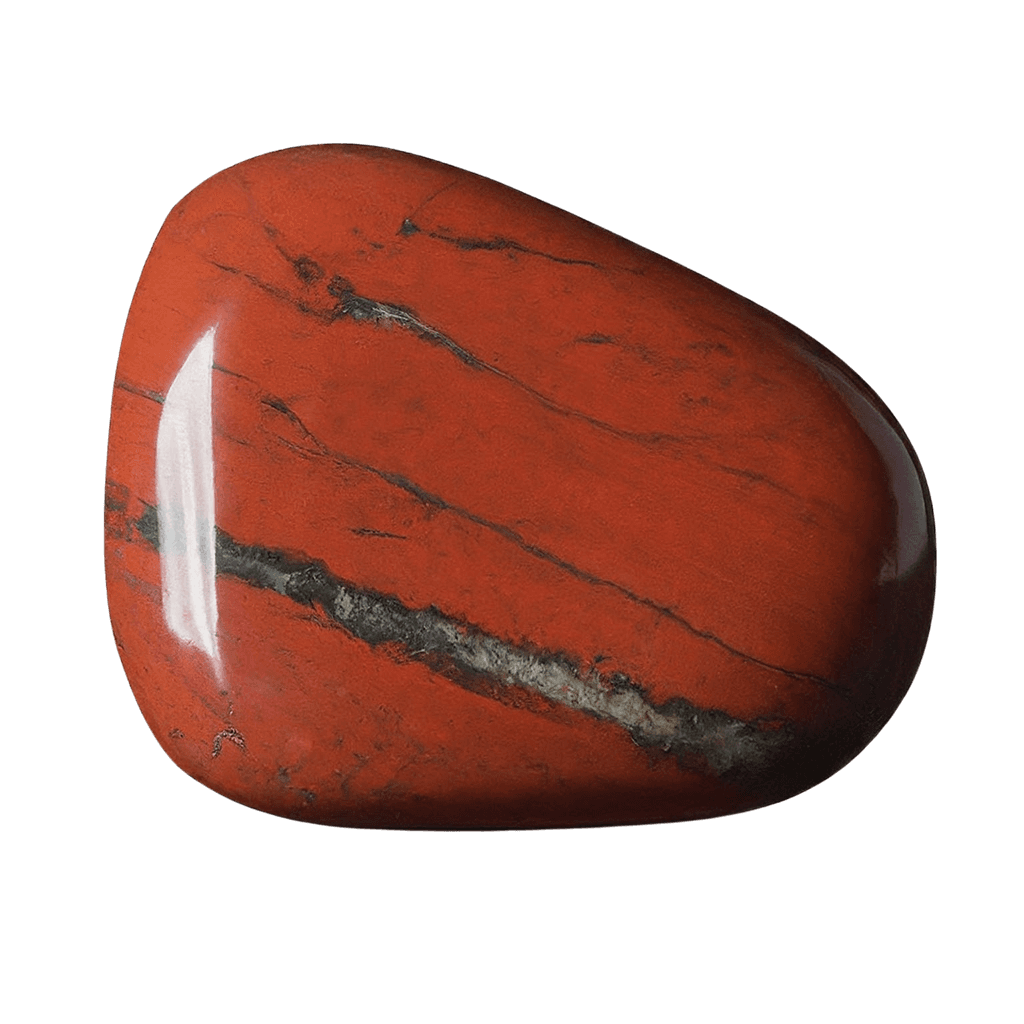
If you typed the bare word, you almost certainly mean red jasper. It is the archetype, and the family's whole reputation for steadiness rests on it. Yellow jasper is the same rock at a different iron chemistry, so choosing between red and yellow is choosing a temperature rather than a mineral, so choosing between red and yellow is choosing a temperature rather than a mineral. Green jasper is the same body at a third iron and silicate chemistry. Blue jasper is the one to slow down on, because anything vivid deserves the dye question first.
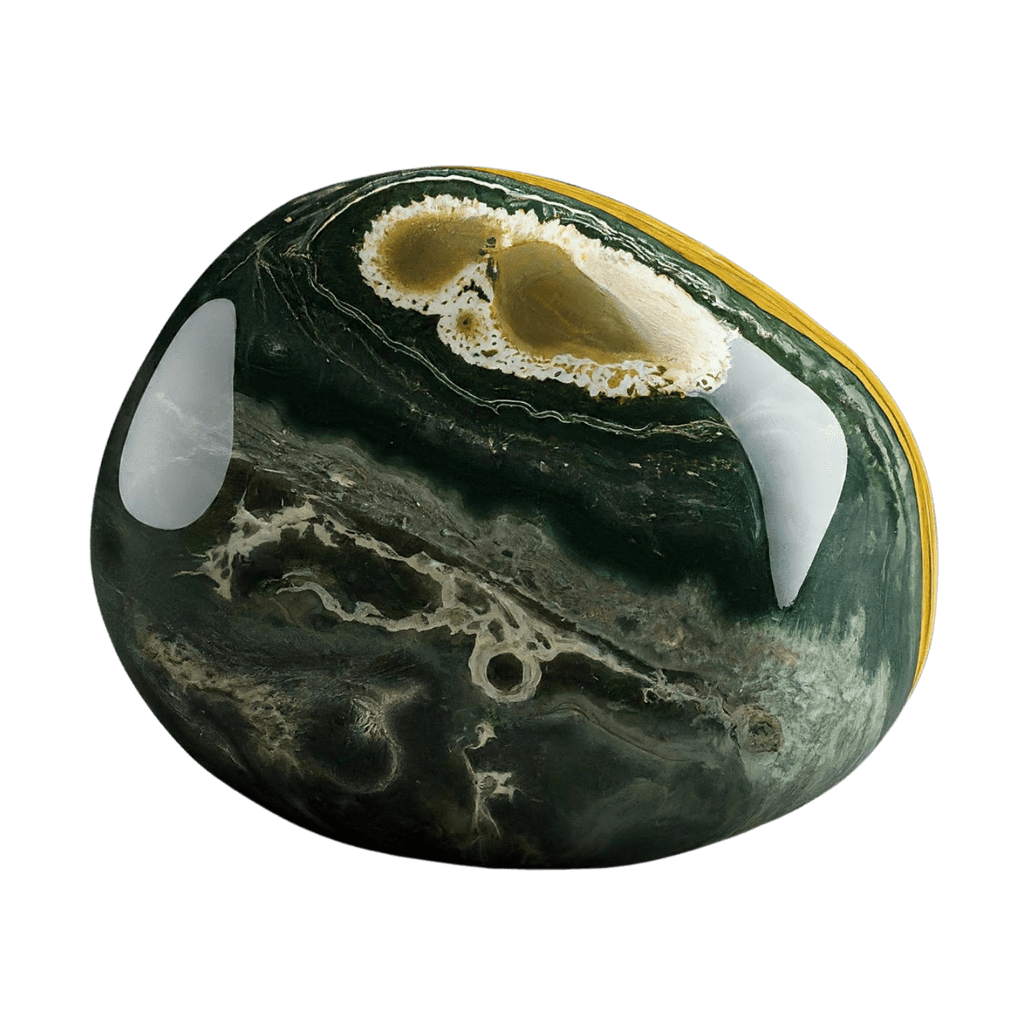
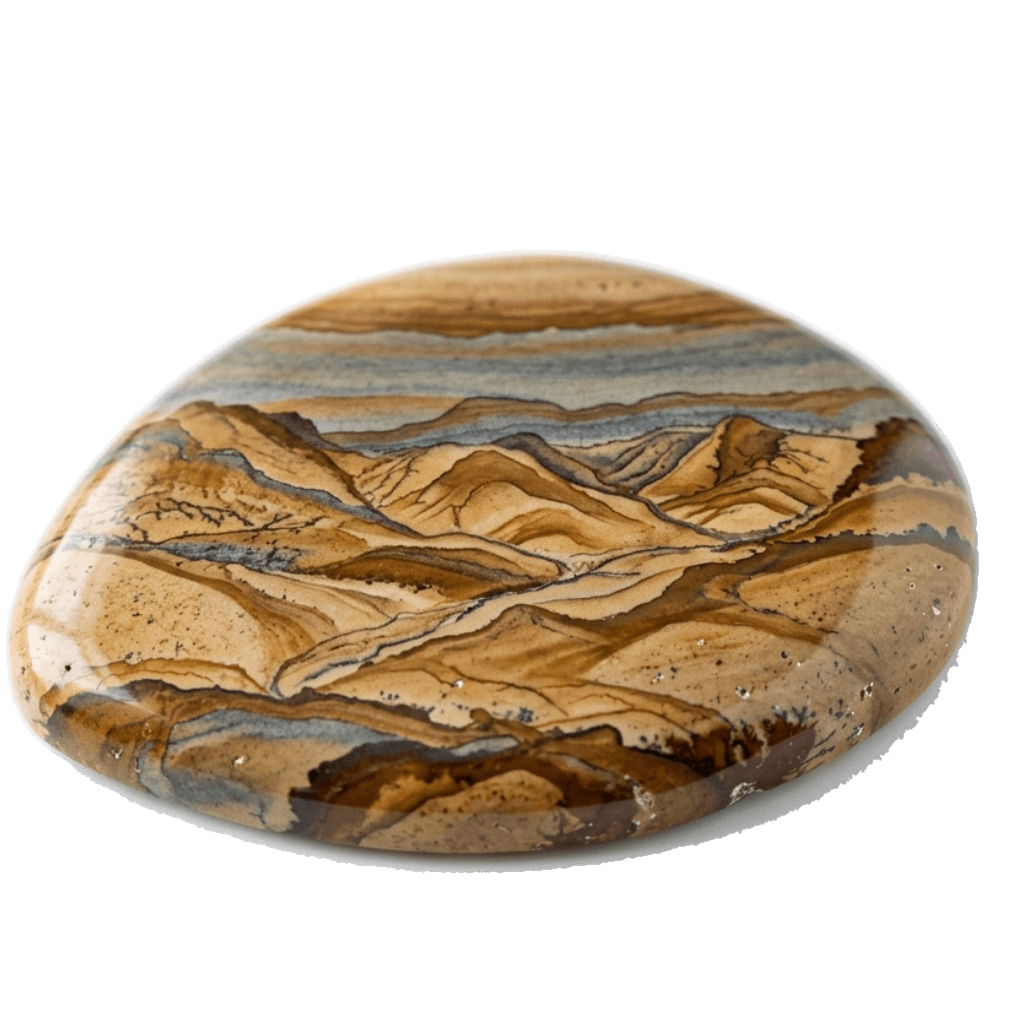
If you came for a pattern, the choice is a picture making one. Picture and landscape jasper are the scenic materials, chosen slab by slab for whether the banding reads as a horizon or merely as brown stripes. Ocean and orbicular jasper are the eye and orb materials from Madagascar, and they are also the two most likely to be part agate, since their edges often go translucent. Poppy jasper is the orbicular material with the flower bloom, brecciated jasper is the one whose pattern records being shattered and cemented back together, polychrome is the many colored Madagascan desert material cut into large spheres and free forms, red sesame is the speckled one, and mookaite is the Australian radiolarite whose silica came from plankton skeletons.
Then there is the group that needs a different sentence entirely, because it is not jasper: leopardskin, kambaba, dalmatian, zebra and bumble bee. Leopardskin and kambaba are rhyolites: the analysis reported for kambaba by EPI, a German gemstone testing institute, describes a green groundmass of quartz, the pyroxene aegirine and soda and potash feldspars, with the orbs built from very small amphibole needles, which is an igneous assemblage rather than the stromatolite the trade sells. Four of those five still behave like durable stone. Bumble bee does not, and it is the single member of this family where the standard jasper care sentence would be wrong.
Market figures, for orientation only. The CrystalStones.com store is not open, so none of this is an offer. Common jasper is one of the cheapest things in the polished stone market, because the material is abundant on several continents, cuts easily and takes a bright polish without special handling, so tumbled and small polished pieces of the everyday jaspers sit in the low single digit dollars. The International Gem Society puts commercial quality material cut in simple shapes at around $5 or less in rock shops, and fine designer cut material at roughly $2 to $5 per carat, which is the point where a buyer stops paying for stone and starts paying for pattern. The premiums here are driven by locality rather than by quality of substance, because the substance is the same everywhere: Morgan Hill poppy jasper ground is private and not commercially mined, and first vein Marovato ocean jasper and old Biggs rough sell as old stock for the same reason. What actually moves a price, in order: how completely the pattern resolves, whether the locality is closed, the size of an unbroken defect free slab, polish quality, and honest color. In my practice the caution worth more than any of those numbers is simpler: a vividly uniform blue or purple jasper priced like common jasper is almost certainly dyed, and the dye is the part that does not last.
How to Spot Real vs Fake Jasper
The market in Jasper has grown faster than its honesty, and multicolored pieces are easy to imitate on a screen. Here is how to check one before you pay for it:
Temperature: genuine Jasper feels distinctly cool at first touch and gives that coolness up slowly; resin copies feel warm almost immediately, which is the quickest tell there is.
Weight: real Jasper should feel like stone rather than plastic pretending; if a palm-sized piece feels nearly weightless, walk away from it.
Color and pattern: natural Jasper runs multicolored, red, or yellow, with variation from piece to piece; perfectly uniform color across a whole tray is the classic mark of dye or synthetics.
Trust your source: provenance beats any hands-on check; ask where the Jasper was mined and whether the multicolored material is treated, and expect straight answers rather than adjectives.
Frequently Asked Questions
What is Jasper good for?
Jasper is traditionally associated with grounding, vitality, courage, and protection. Many people find it supportive for grounding and for working with the Root chakra.
Can Jasper go in water?
Yes. Jasper is water-safe at Mohs 7, so a brief rinse under cool running water is a perfectly good cleanse. Dry it afterward and skip long soaks, which no tumbled stone loves.
Can Jasper be in the sun?
Sun is fine for Jasper. A half hour of direct morning light both cleanses and charges it, and the multicolored tones are stable enough to take it.
What chakra is Jasper?
Jasper is primarily associated with the Root (Muladhara) chakra. Work it low, at the hips or on the floor between the feet while seated, which is the traditional station for grounding.
What zodiac sign is Jasper for?
Jasper is traditionally connected to Leo and Aries. That said, the zodiac correspondence is an invitation rather than a requirement; any chart can work with Jasper, and attraction to the stone matters more than the calendar.
How do I cleanse Jasper?
The best methods for Jasper are Water, Sunlight, and Sage. True jasper is one of the most forgiving stones in the CrystalStones.com catalog, with no cleavage direction at all, so water, sun and salt are all fine and it takes daily wear. The amendment is family wide rather than fussy: confirm the piece really is jasper first, because bumble bee is a soft carbonate rock and much zebra material is marble, and neither takes the same handling.
Is Jasper real or fake, how can I tell?
Genuine Jasper feels cool at first touch and warms slowly; at Mohs 7 it also resists the pocket scratches that mark softer fakes. There is no single Jasper price, because each variety carries its own market; judge a piece against its own variety and expect visible variation rather than uniformity.
Is jasper a real mineral?
Jasper is not a mineral species. It is a lapidary name for opaque microcrystalline quartz, and Gemdat classes it only as a variety of chalcedony, which is a variety of quartz. Walter Schumann's Gemstones of the World records that dense jasper carries up to 20 percent foreign material, which is why mineralogy treats the word as a rock name governed by no nomenclature authority at all.
What is the difference between jasper and agate?
Jasper and agate are both microcrystalline quartz, and opacity is what separates them. The Geology.com field procedure reads a fresh conchoidal break: opaque means jasper, translucent and banded means agate, translucent and unbanded means chalcedony, and a vitreous luster on that break means coarsely crystalline quartz instead. Red jasper and carnelian can be an identical color, with translucency the only difference.
Which stones sold as jasper are not actually jasper?
At least five of the nineteen jaspers CrystalStones.com lists under that name are not microcrystalline quartz. Leopardskin and kambaba are rhyolites, dalmatian is a spotted igneous rock, much zebra material is banded marble or quartzite, and bumble bee is a carbonate rock colored by arsenic sulfide. Ocean and orbicular jasper also fail the opacity test wherever their edges go translucent, which strictly makes those parts agate.
What is the difference between jasper, chert, and flint?
Jasper, chert and flint are often the same material called three different things. Geology.com puts it plainly: the same hand specimen might be called chert by one person, flint by another and jasper by a third, with geologists tending toward chert, archaeologists toward flint, and the lapidary trade toward jasper for pieces worth cutting and polishing.
Which jasper should a beginner start with?
Red jasper is the sensible first jasper, the archetype this family's reputation rests on and the easiest to find honestly labeled for a few dollars. Choose picture or landscape jasper instead if you want a scene rather than a color, ocean jasper if you want the orbs, and mookaite if you want a single verified locality.
What’s Next?
A few thoughtful next steps if Jasper is calling to you.
Explore More Tools
Crystal Quiz
Discover which crystal matches your energy right now.
Open →Chakra Test
Find which chakras need attention and the crystals to balance them.
Open →Crystal Cleansing Guide
Learn how to safely cleanse and charge your crystals.
Open →Crystals by Intention
Find the perfect crystal for what you need right now.
Open →