Quick Answer
Tourmaline is a multicolored crystal used in modern crystal healing for protection, grounding, and heart healing. It measures 7 on the Mohs hardness scale. In the chakra tradition, Tourmaline is associated with the Root and Heart chakras.
Worth knowing: Tourmaline is named for the confusion it caused: the word comes from the Sinhalese toramalli, mixed gems, the term Dutch merchants used for unsorted parcels of coloured Sri Lankan pebbles that nobody could classify.
“A boron silicate supergroup of 32 recognized minerals, and the parent of four catalog varieties plus one that is not tourmaline at all.”
- Chakra
- Root (Muladhara), Heart (Anahata)
- Zodiac
- Libra ♎, Scorpio ♏
- Element
- Earth 🌍
- Planet
- Saturn ♄
- Hardness
- 7 / 10 (Mohs)
- Colors
- Multicolored, Black, Pink, Green, Blue, Red, Watermelon
- Origin
- Brazil, Afghanistan, Pakistan, Madagascar, Nigeria, USA
- Availability
- Not sold here yet
Care + Safety
Tourmaline at a glance
- Water: brief rinse safe
- Sun: tolerates sunlight charging
- Mohs hardness: 7 (durable for daily-wear jewelry)
What is Tourmaline?
Tourmaline is not a mineral, it is a supergroup. Geology.com records that the International Mineralogical Association recognizes 32 different tourmaline minerals separated by chemical composition, all of them complex boron silicates built on one trigonal structure and differing in which metals occupy the same handful of lattice sites. Three species account for nearly everything in circulation: schorl, the sodium iron end member, which Geology.com calls the most commonly found variety and which is what every black tourmaline in this catalog actually is; elbaite, the lithium bearing species behind the pink, green, blue and watermelon material; and dravite, the magnesium brown one. The physical numbers hold across the supergroup: Mohs 7 to 7.5, cleavage indistinct, and the deeply striated three sided prism that survives in almost every crystal the family grows.
Tourmaline measures 7 on the Mohs scale and shows multicolored, black, or pink coloring. Practitioners shelve it with the keeper stones at the protective end of the catalog, where protection, grounding, and heart healing are the standing requests.
The stone connects primarily to the Root (Muladhara) and Heart (Anahata) chakras, carrying Earth energy. Commercial material comes from Brazil, Afghanistan, Pakistan, Madagascar, Nigeria, and USA, and provenance shows: pieces from different deposits vary in saturation, veining, and clarity, which is why no two specimens of Tourmaline read quite alike.
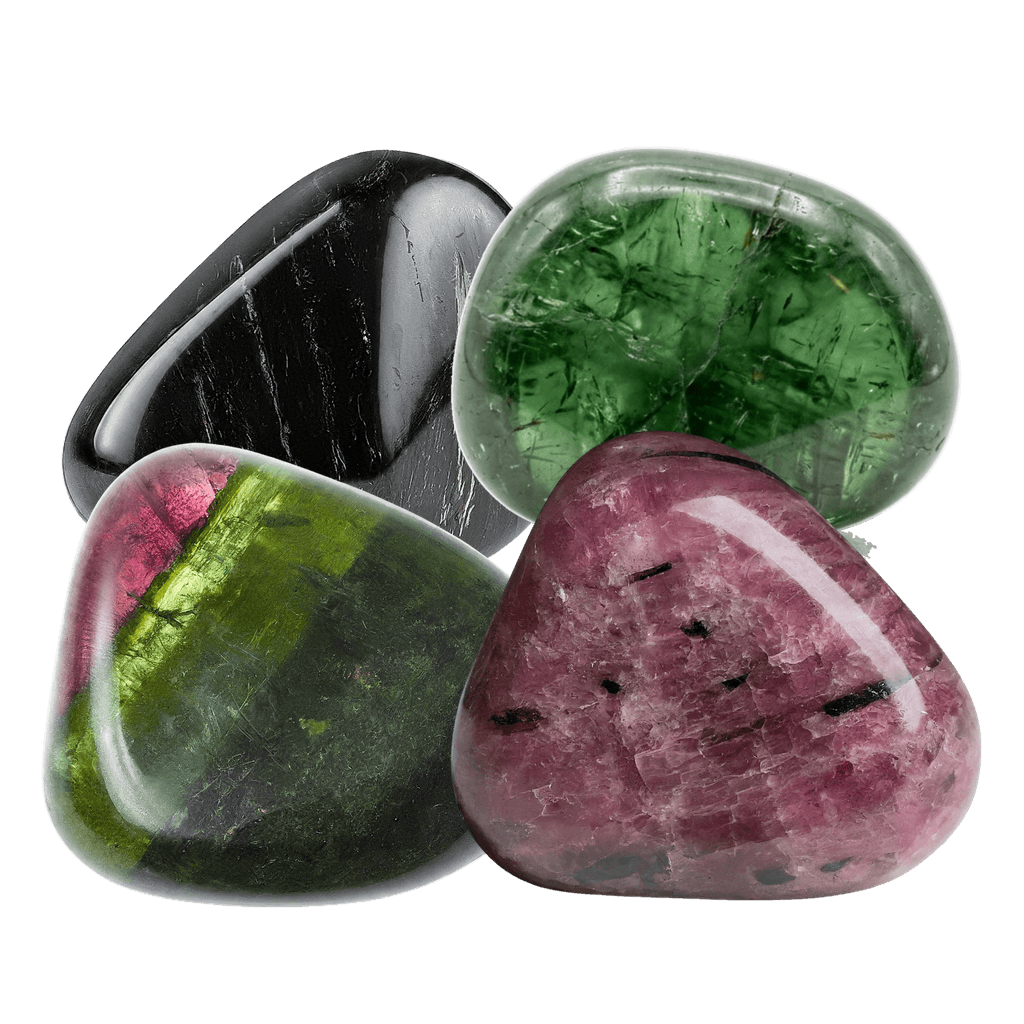
Tourmaline is a supergroup, not a stone. Four tourmalines in the CrystalStones.com catalog sit under this name and by eye they share almost nothing: one is opaque black, one is clear pink, one is a green deep enough to read as bottle glass, and one carries several of those at once in a single sliced crystal. What they do share is a shape. Hold any of them and roll it slowly between finger and thumb, and notice the same three sided prism and the same deep grooves running the whole length of the crystal. That striated column is the family signature, and it is the one thing colour cannot disguise.
Also catalogued as Tourmaline Supergroup, Toramalli, and Schorl, Tourmaline earns its place in a working collection by being usable: start with protection, the job it is best known for, and let the stone widen its own brief from there.
4 stones are catalogued under the tourmaline name, each with its own entry: Black Tourmaline, Pink Tourmaline, Watermelon Tourmaline, Green Tourmaline.
History and Mythology
The name is a record of failure to identify it. Tourmaline comes from toramalli, a Sinhalese term meaning mixed gems, which is what Dutch merchants called the parcels of multicoloured water worn pebbles arriving from Sri Lanka, because nobody could sort them into the categories then in use. The confusion was not only linguistic. GIA records sixteenth century Portuguese explorers in Brazil shipping green and blue tourmaline home in the belief that they had found emeralds and sapphires, and the stone was not recognised as its own mineral until the 1800s.
Its strangest chapter is American, and it ended in a revolution. The Tiffany gemologist George F. Kunz wrote up the tourmaline deposits of Maine and California in the late 1800s and made the stone an American gem. The buyer who mattered was in Beijing: the Qing Empress Dowager Cixi developed such an appetite for pink tourmaline that she bought close to the entire output of a San Diego County mine, had much of it carved, and was laid to rest on a pink tourmaline pillow. The San Diego mines, among them the Himalaya, Tourmaline Queen, Tourmaline King, Stewart and Pala Chief, grew so dependent on that single customer that when the Chinese government fell in 1912 the American tourmaline trade fell with it.
The most recent chapter is a colour nobody had seen before. In 1989 and 1990, elbaite coloured by trace amounts of copper was found in pegmatite pockets in Paraiba and Rio Grande do Norte, Brazil, in a bright blue to bright green that no other tourmaline produces.
Tourmaline Meaning and Metaphysical Properties
First Touch
Tourmaline announces itself through temperature: a cool, multicolored, glass-polished weight at Mohs 7 that warms deliberately, not instantly, inside a closed palm. Attend to heaviness rather than to tingling. Ballast is the quality this family is traditionally read for, so that is the thing worth giving your attention to.
Primary Properties
Protection is the through-line in the Tourmaline properties: protection, grounding, heart healing, transformation, and energy. Stones of this family work like good walls, defining rather than confining, and their gift is the slower breath of feeling contained. Treat the traditional list as a sketch; the steadiness you actually need is the version worth practicing.
How Crystal Energy Works
In traditional crystal healing Tourmaline is read through the Root center, the body's claim to ground, and protection is the quality it is most often asked to bring there. Root work is low and slow, seated practice, feet flat, with protection, grounding, and heart healing as the standing assignment. Melody's Love Is in the Earth describes the grounding stones through the root connection, the energetic cord she pictures running from the base of the spine into the earth itself.
Amplification Through Intention
The Earth designation means Tourmaline favors repetition: daily handling, a fixed home on the shelf, the protection intention restated in plain words. That steadiness is the whole method.
Healing Benefits
Emotional Support
On the emotional level, tradition hands Tourmaline the boundary work: protection, grounding, and heart healing, the felt sense of having walls that hold. It earns its keep on the days when other people's storms blow through you too easily. These are traditional protection associations rather than medical claims; for anything heavy or persistent, a qualified professional belongs in the picture alongside any stone.
Spiritual Connection
In spiritual work Tourmaline plays the doorkeeper: it is the stone tradition assigns to opening and closing practice, the grounding breath before inner work and the deliberate return after. Boundaries, in this family, are a devotion of their own.
Physical Presence
Tradition reads Earth stones like Tourmaline through the soles of the feet: stance, weight, the felt fact of standing somewhere while you work on protection. Try standing barefoot with the stone in hand when the day goes abstract; the practice is awareness, not medicine.
Chakra Connection
Tourmaline resonates most strongly with the Root (Muladhara), the energy center traditionally drawn in red and the traditional seat of this stone's protection work. When this center runs clear, the classical markers are steadiness, physical security, and a settled sense of ground; protection, grounding, and heart healing are what Tourmaline is most often asked to bring to it.
Work it seated and slow; put Tourmaline on the floor where your gaze lands, feet flat, and breathe down toward it. Root work is the least dramatic chakra work there is, which is exactly why protection grows well in it.
Because Tourmaline is also associated with the Heart (Anahata), it moves well in multi-stone layouts: one stone, two stations, worked on different days.
Zodiac and Astrological Connection
In the modern correspondence tables Tourmaline is assigned to Libra ♎ (Sep 23 to Oct 22) and Scorpio ♏ (Oct 23 to Nov 21); a Sun, Moon, or rising placement there is read as a head start with this stone, nothing more.
Correspondence is a suggestion, not a bouncer; plenty of devoted Tourmaline keepers have no Libra in their chart at all, and being drawn to the stone is the credential that matters.
In the planetary layer of the system, Saturn ♄ holds the rulership, and that planet's prominent transits are the traditional windows for deeper protection work with Tourmaline.
How to Use Tourmaline
Five practices suit Tourmaline especially well. Pick the one that fits the day you are actually having rather than the routine you think you should have.
- 1
Meditation Hold
Begin the sit with Tourmaline against the skin and use its coolness as the focus; at Mohs 7 it holds that freshness for a while before giving in to body heat.
- 2
Body Placement
Floor and hip are the two Root stations in the old placement charts, and Tourmaline takes either one: by the feet during seated work, at the hips when lying back. In my practice the interesting part is never the position itself but what you catch yourself noticing once you stop expecting anything from it, which is how the tradition's protection work was meant to be entered.
- 3
Sleep Companion
Tourmaline can still earn the nightstand even though its brief is protection rather than rest: setting the stone down as you set the day down marks the switch from doing to sleeping.
- 4
Carry With You
Bring Tourmaline along when the calendar promises crowds, noise, or rooms you would rather skip. Each touch-check restates the boundary, two seconds of contact saying that protection travels with you.
- 5
Crystal Grid Anchor
For grid work, give Tourmaline the anchor position and run Black Tourmaline and Pink Tourmaline on the outer points, all matched to a single protection intention. Rebuild it when it goes stale; a protection grid you have stopped seeing has stopped working.
How to Cleanse and Charge
Tourmaline works best when it is cleansed on a rhythm; tradition pictures a stone absorbing what it meets, and a saturated stone has nothing left to give. The complete water, sun, and salt safety profile, plus the storage instructions I give my clients, lives in the dedicated Tourmaline care guide.
- 1
Water
Run cool water over Tourmaline while turning it slowly; when the surface feels fresh under the thumb, dry it well and let it rest before its next use.
- 2
Salt
Bury Tourmaline in a bowl of dry sea salt for four to six hours, then discard the salt rather than reusing it; salt holds what it pulls.
- 3
Sage
Pass Tourmaline through the smoke of white sage or rosemary for about thirty seconds, turning it so the smoke wraps every face, while you hold a clear intention of release.
- 4
Moonlight
Give Tourmaline a night outdoors or at the glass under a bright moon; the tradition holds moonlight to be the universal reset, slow, cool, and risk-free.
- 5
Sound
Hold Tourmaline near a singing bowl, bell, or tuning fork and let a full minute of tone wash over it; sound reaches stones that water, salt, and sun cannot safely touch.
How often to cleanse
Monthly is the floor for Tourmaline; step the cadence up whenever the stone is in daily rotation or the season is emotionally loud. With practice you will feel the tell yourself, a worked stone reads heavier and flatter in the palm.
Charging after cleansing
Once it is cleansed, recharge Tourmaline by placing it in morning sunlight for 30 minutes; cleansing empties the stone, charging refills it.
The Crystal Starter Library
A free guide from Crystal Cassandra: the twelve stones that cover almost everything, a one page care matrix for water, sun and salt, and how to build a first intention practice.
We respect your inbox. Unsubscribe anytime.
Crystal Pairings
Think of pairing Tourmaline as staffing a gate: something heavy to hold the line, something quick to keep watch. The traditional companions split exactly that work, boundary on one side, vigilance on the other. Before settling on a pair, hold both for a moment; comfort in the hand is the yes.
Buying Tourmaline: Price, Quality, and Jewelry
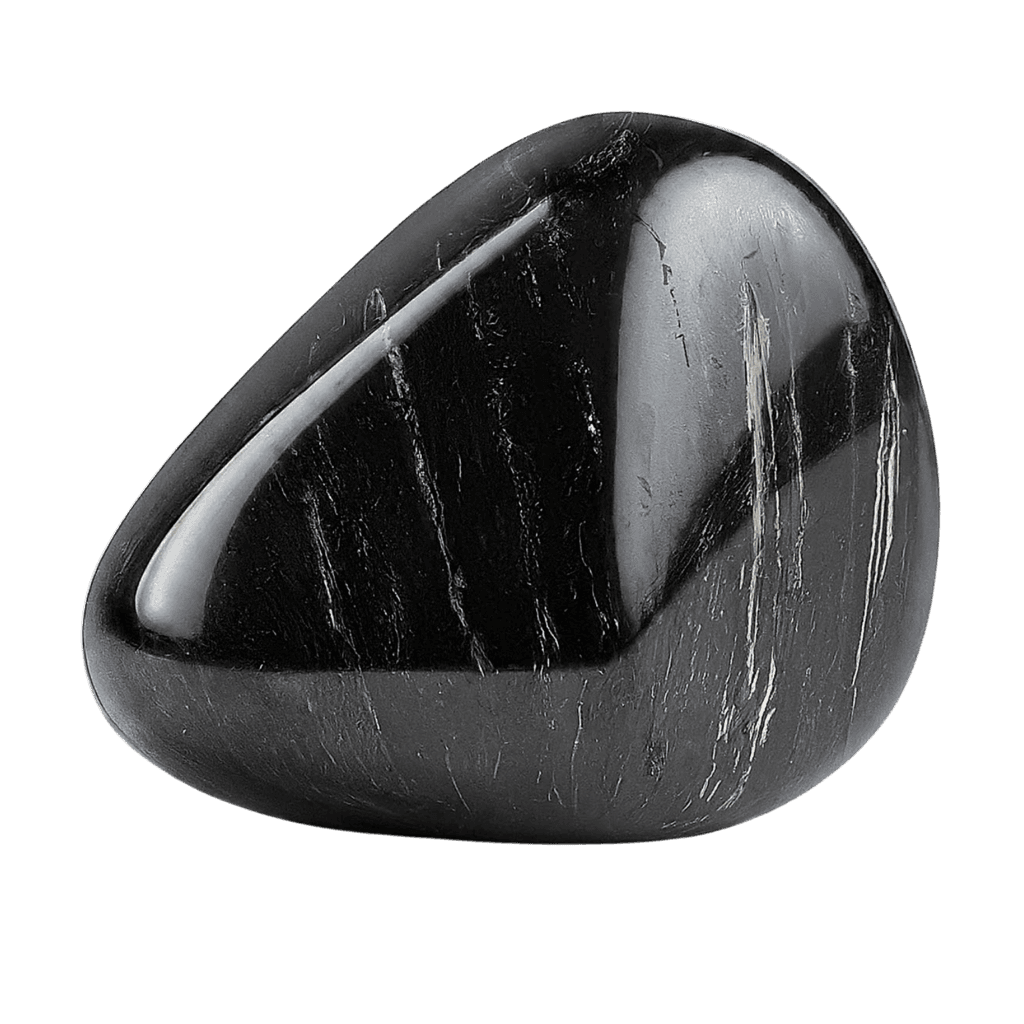
If you typed the bare word, the odds are you mean black tourmaline, because schorl is the abundant species and the family's protective reputation rests on it. It is also the cheapest way into the supergroup by a wide margin. Almost everything else here is elbaite, and elbaite is where the price lives.
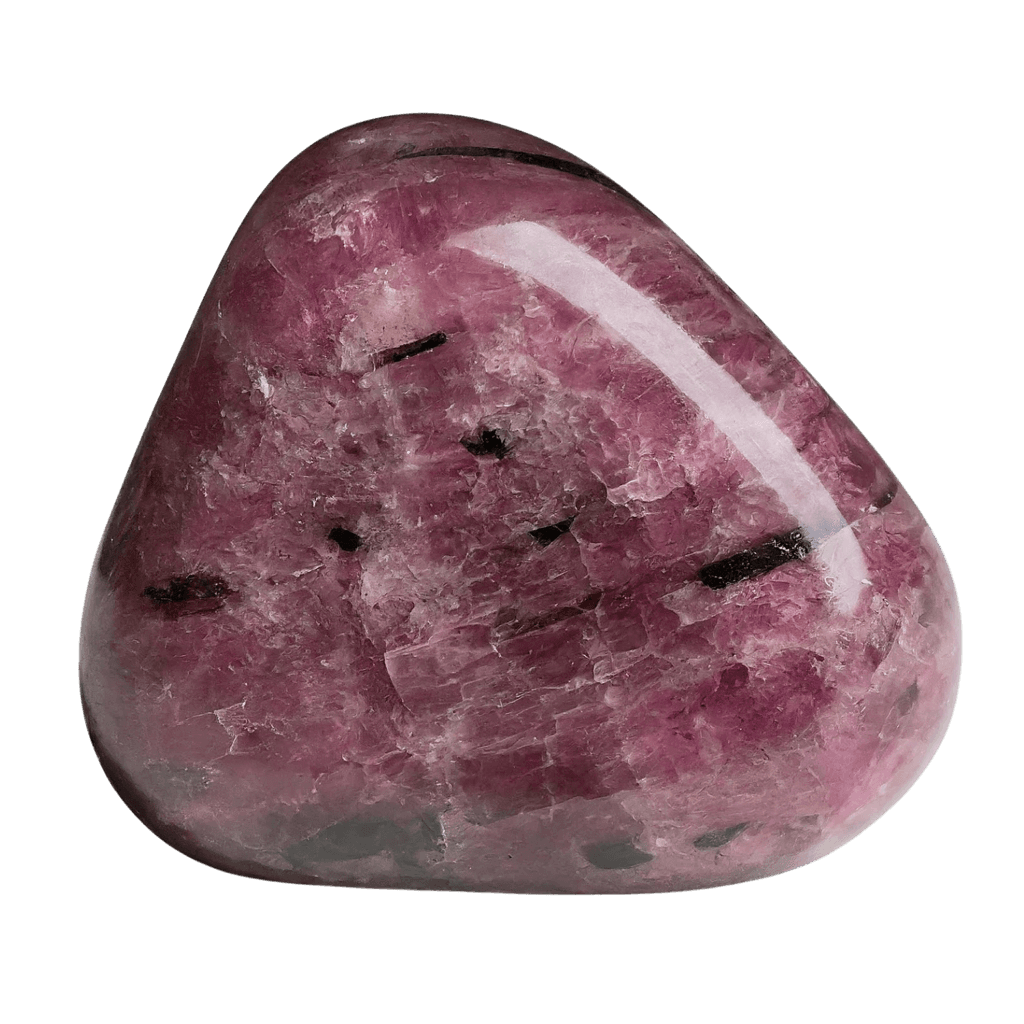
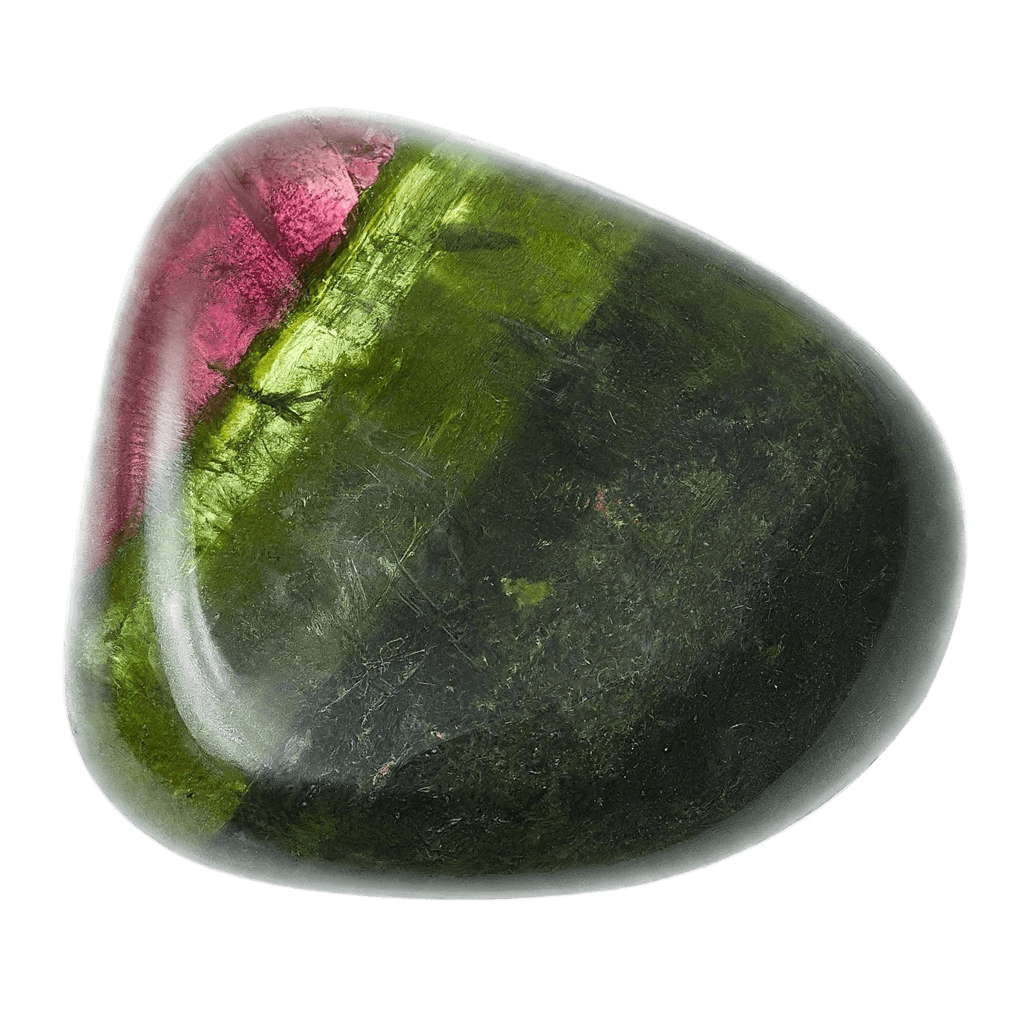
Choose by colour, because in this family colour is the species and the price at the same time. Pink and red elbaite is sold as rubellite, blue as indicolite, green as verdelite, and a slice with a pink core and a green rim as watermelon tourmaline, which is one crystal that changed its chemistry as it grew rather than two stones joined together. Paraiba is the copper bearing outlier and is priced in a different market from the rest.
Two honesty checks matter more here than in most families. Pink and red tourmaline is routinely irradiated to deepen colour, a treatment that holds up in normal wear but that heat can undo, which is why a jeweller should be told what is in a setting before a torch goes near it. And tourmaline is brittle in a way its hardness number does not warn you about: gem elbaite grows full of inclusions and long crystals frequently arrive already cracked across the prism, so a slender tourmaline bead deserves more care than Mohs 7 to 7.5 implies.
Market figures, for orientation only. The CrystalStones.com store is not open, so none of this is an offer. Rough and tumbled black tourmaline sits in the low single digit dollars, because schorl is abundant and mined on several continents. Ordinary green and pink elbaite moves into per carat pricing as soon as it is clean enough to facet, and Paraiba sits at the far end of the coloured stone market entirely, at levels that have nothing to do with the rest of this family. What moves a price here, in order: species and colour, saturation, clarity, whether the colour is natural or induced, and size. In my practice the simpler rule is worth more than any of those: a large, clean, vividly coloured tourmaline offered at black tourmaline money is telling you something about itself.
How to Spot Real vs Fake Tourmaline
Imitations of Tourmaline exist because demand does. A few hands-on checks separate genuine multicolored material from glass, resin, and dye:
Temperature: genuine Tourmaline feels distinctly cool at first touch and gives that coolness up slowly; resin copies feel warm almost immediately, which is the quickest tell there is.
Weight and density: resin fakes run light for their size, while genuine Tourmaline at Mohs 7 carries honest mineral density; weigh it in the palm against any real tumbled stone you own.
Color and pattern: natural Tourmaline runs multicolored, black, or pink, with variation from piece to piece; perfectly uniform color across a whole tray is the classic mark of dye or synthetics.
Trust your source: provenance beats any hands-on check; ask where the Tourmaline was mined and whether the multicolored material is treated, and expect straight answers rather than adjectives.
Frequently Asked Questions
What is Tourmaline good for?
Tourmaline is traditionally associated with protection, grounding, heart healing, and transformation. Many people find it supportive for protection and for working with the Root and Heart chakras.
Can Tourmaline go in water?
Yes. Tourmaline is water-safe at Mohs 7, so a brief rinse under cool running water is a perfectly good cleanse. Dry it afterward and skip long soaks, which no tumbled stone loves.
Can Tourmaline be in the sun?
Yes, Tourmaline can sit in sunlight safely; its multicolored coloring holds up, and thirty minutes of morning sun is the traditional charge.
What chakra is Tourmaline?
Tourmaline is primarily associated with the Root (Muladhara) and Heart (Anahata) chakras. Traditional use keeps it near the ground: at the hips, or set between the feet during seated practice, the root station for protection.
What zodiac sign is Tourmaline for?
Tourmaline is traditionally connected to Libra and Scorpio. Astrological correspondence is one tradition among several, and nothing about your chart disqualifies you; people without a Libra placement work with Tourmaline all the time.
How do I cleanse Tourmaline?
Stick to Water, Salt, and Sage for Tourmaline; those are the methods its care profile recommends. A quick rinse remains an option at Mohs 7, but the listed methods are the ones that should carry the regular routine.
Is Tourmaline real or fake, how can I tell?
Genuine Tourmaline feels cool at first touch and warms slowly; at Mohs 7 it also resists the pocket scratches that mark softer fakes. Price is set by the specific variety rather than by the family name, so compare Tourmaline against others of the same variety and treat honest natural variation as the good sign.
Is tourmaline one mineral?
Tourmaline is not one mineral but a supergroup. Geology.com reports that the International Mineralogical Association recognizes 32 separate tourmaline minerals, distinguished by chemical composition rather than by appearance. They share one trigonal crystal structure and a boron silicate chemistry, and differ in which metals fill the same lattice sites, which is why a black tourmaline and a pink one are different species rather than different colours of the same stone.
What is the difference between schorl and elbaite?
Schorl and elbaite are the two tourmaline species most people actually meet. Schorl is the sodium iron member, opaque black, by far the most commonly found variety, and it is what every black tourmaline in the CrystalStones.com catalog is. Elbaite is the lithium bearing member and the one that produces colour: pink, red, green, blue and the watermelon material are all elbaite. Price follows that split almost exactly.
Is tourmalinated quartz a tourmaline?
Tourmalinated quartz is not a tourmaline. It is clear or milky quartz that grew around black schorl needles, so the tourmaline is an inclusion rather than the stone itself, and the host is ordinary quartz. Of the six stones filed under the tourmaline name in this catalog, it is the only one that is not a member of the supergroup at all.
Why is Paraiba tourmaline so expensive?
Paraiba tourmaline is expensive because of a colour cause found almost nowhere else. Geology.com records that in 1989 and 1990 elbaite coloured by trace copper was found in pegmatite pockets in Paraiba and Rio Grande do Norte, Brazil, producing a bright blue to bright green no other tourmaline makes. The original deposits were small and quickly worked, so scarcity and an unrepeatable colour set the price together.
Which tourmaline should a beginner start with?
Black tourmaline is the sensible first tourmaline. It is the most abundant species in the supergroup, the cheapest to buy honestly labelled, and durable enough to be handled daily without much thought. Choose watermelon tourmaline instead if you want to see what makes this family unusual, since a single sliced crystal showing a pink core inside a green rim is the clearest demonstration that colour here is chemistry changing as the crystal grew.
What’s Next?
A few thoughtful next steps if Tourmaline is calling to you.
Explore More Tools
Crystal Quiz
Discover which crystal matches your energy right now.
Open →Chakra Test
Find which chakras need attention and the crystals to balance them.
Open →Crystal Cleansing Guide
Learn how to safely cleanse and charge your crystals.
Open →Crystals by Intention
Find the perfect crystal for what you need right now.
Open →